The edge
A Working Farm You See From the Lane
A genuine working farm inside the county line, with a public lane down one flank and a gate that does not open for visitors. The lane is the whole offer, and it is a better one than it sounds.
The four questions
| Whose ground it is | An institution that farms the ground for its own purposes, with livestock, machinery and liability, none of which improves by adding a stranger. |
|---|---|
| How far in you get | The lane, on foot, its full length, at any hour. Not the gate, not the pasture, not the yard, not ever. |
| What it costs to be there | Nothing, and the price of keeping it that way is that everybody stays on the gravel. |
| What going wrong looks like | Climbing anything. A single visitor in a pasture is how a public lane becomes a private one, permanently, for everybody after you. |
Why the gate stays shut
Three reasons, and only one of them is about you.
Livestock, which move, are large, and behave differently when a stranger is in the field. Machinery, which is running somewhere on the property most working days and is not looking for pedestrians. And insurance, which is the reason the first two are not negotiable no matter how carefully you would behave.
None of this is unfriendliness. A working farm is a workplace with the roof off, and nobody expects to wander through a workshop either.
What the lane gives you
More than the gate would.
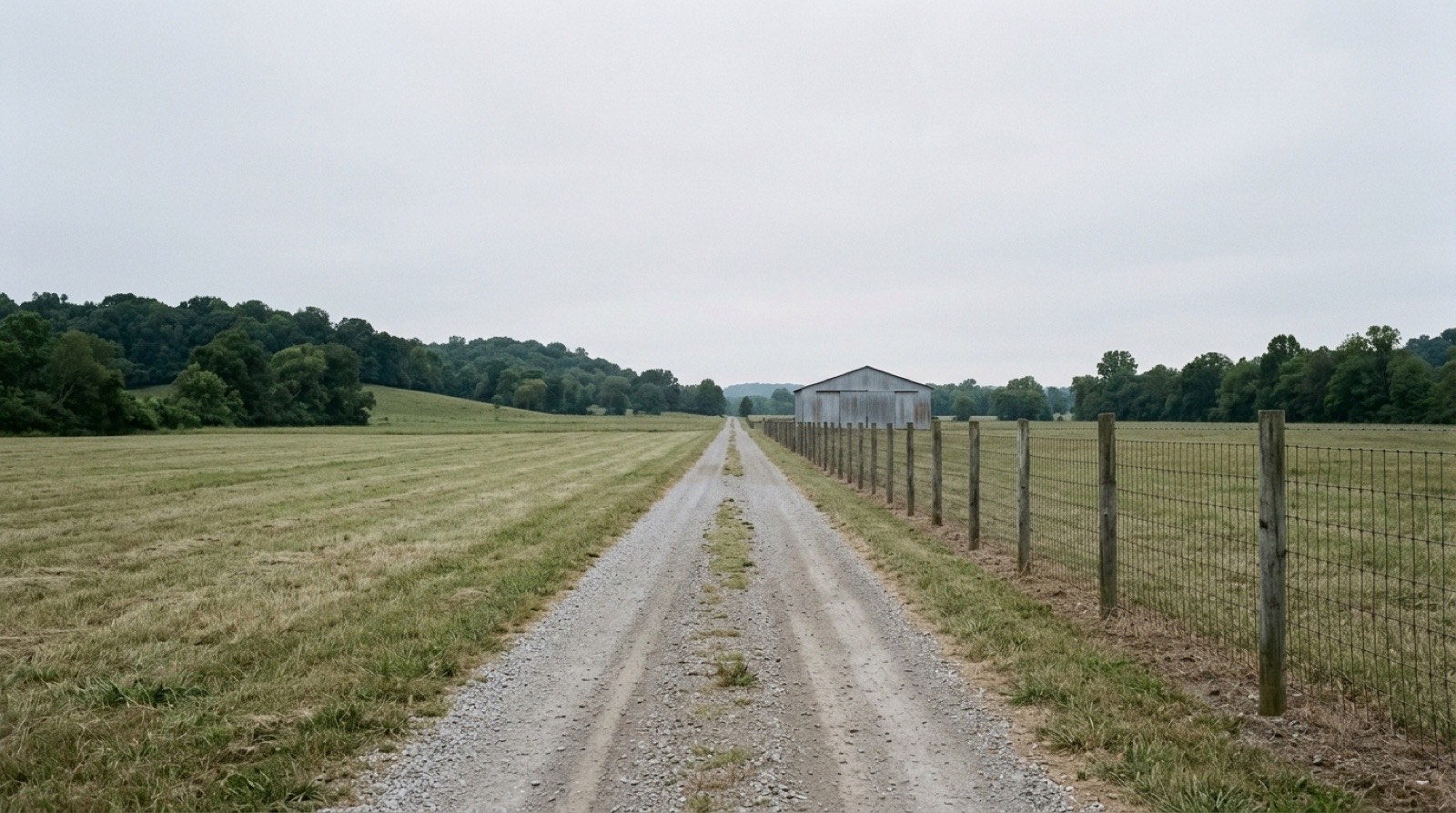
From the gravel you can see the whole shape of the operation at once: which fields are in what, where the water is, how the ground falls, where the equipment tracks run. Inside the fence you would see a gate post.
You also get the edge itself, which is the richest strip of ground on the property. A mown margin against a wire fence, unsprayed, uncultivated, is where everything lives. In half a mile we have counted more going on in the verge than in the entire field beside it.
The hour that matters
Late afternoon, on a working day, when things are moving.
A farm at eleven on a Sunday is a photograph. A farm at four on a Tuesday is a place doing something, and the lane is close enough that you can tell what. That is the whole argument for the edge as a category: being outside the fence at the right hour beats being inside it at the wrong one.
The rule, and it is the only one
Stay on the gravel.
We would rather write one plain sentence than a list of exceptions, because the exceptions are what people remember. There are none. The lane is public and everything on the other side of the wire is not, and the wire is not ambiguous.
Practical
- Gravel, level, about half a mile, no shade at all.
- No facilities and no water. The nearest of either is a long way.
- Farm traffic uses the lane. Step off it and let anything with a tractor past.
- Ticks in the verge from April. Stay on the gravel and this is not your problem.