Nobody to ask
A Quadrangle You Can Walk Through
The commonest piece of half public ground in this city, and the one visitors stand at the edge of and then go around.
The four questions
| Whose ground it is | A university, which owns the grass, the paths and the buildings on all four sides, and which has no interest at all in who crosses the middle of it. |
|---|---|
| How far in you get | All the way across, on the paved footways, at any hour. Not into the buildings, not onto the grass during a set piece, not through a service yard. |
| What it costs to be there | Nothing, and there is nobody to pay. The cost is the small discomfort of walking somewhere that never told you it was allowed. |
| What going wrong looks like | Somebody asks what you are looking for. That is the whole of it, and the honest answer, that you are walking through, ends the conversation. |
The thing nobody puts on a sign
A campus of this kind has three or four ways in, and not one of them carries a sign that says the public may walk here. What they carry instead is a name, sometimes a date, and a request about vehicles.
This is not an oversight and it is not a trap. Ground like this has been crossed by whoever wanted to cross it for a century, and the arrangement is so old that nobody thinks to write it down. The people who work here cross it forty times a week and would find a permission sign strange.
The absence of a welcome is the hardest thing about the whole band, and it is why we put this piece first. Half the ground in this book has nothing at the entrance, and a visitor who waits to be invited will never go in.
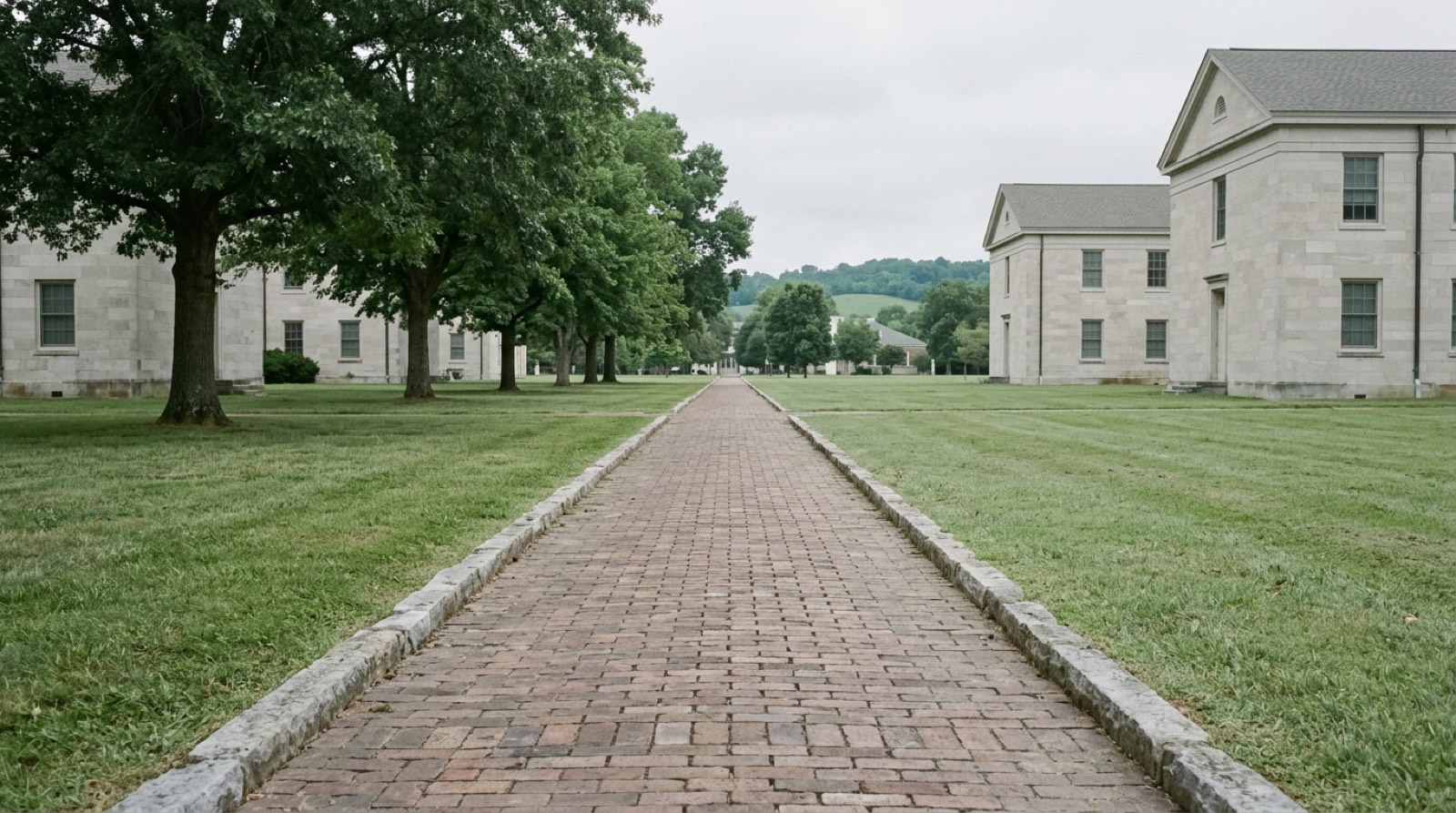
How to read it in ten seconds
- The paths are made for walking, not for maintenance. Brick or flagstone laid in a pattern, wide enough for two, with benches along them. Service ground is asphalt and it is wide enough for a truck.
- Nothing is chained. Gates that stand open and have clearly stood open for years have hinges that have stopped working. Look at the hinge.
- The grass is mown to the edge of the path and no further in some places. Where a lawn is manicured to the last inch and roped at the corners, something is being protected and you should stay off it.
- Somebody else is doing it. A person crossing with a coffee is worth more than any sign.
What actually stops you
Two things, and neither of them is a rule.
The first is a set piece: a ceremony, a photograph being taken, a marquee going up. The ground has been temporarily borrowed by an occasion and you walk around the edge of it without being asked.
The second is a building. Every door on the quadrangle is a different question from the quadrangle itself, and the answer is usually no. Crossing the grass is not permission to try a handle.
The hours nobody keeps
There are none, which is the definition of this band, and it is worth being precise about what that means. It does not mean the place is safe or lit or that anybody is about. It means that no clock governs your right to be there.
We have crossed ground like this at six in the morning and at eleven at night and been asked nothing on either occasion. That is not a promise, it is a report.
Where the edge really is
The quadrangle is open and the yard behind the buildings is not, and the transition between them is unmarked. It is usually a change of surface: brick becomes asphalt, mown becomes graded, and there is a dumpster.
When the surface stops being made for people, you have left the part that was open. Turn around there. Nobody will tell you.